
Memos
Short commentaries on markets and investor behaviour, to read or to listen to.
Memo, October 2026. Audio and text
Ahead of Nigeria's November MPC Meeting
Falling rates are mostly a test of temperament
Ahead of Nigeria's November MPC Meeting
If you've been to a dinner in Lagos since September, you've probably heard the question: rates are coming down, so where should I put my money now? It's a sensible question, but the number of people asking it at the same time tells us more than any answer I could give.
I don't know what the Committee will do in November. In September nearly every analyst expected a hold, and the Committee cut by 350 basis points to 23 per cent. So I won't offer a prediction. I'd rather think about how investors will behave as rates fall, because that has far more to do with the return they keep than anything decided in Abuja.
Savers don't earn the policy rate. On 7 October the one-year Treasury bill cleared at 15.85 per cent, against inflation of 15.4 per cent. About 6.4 trillion naira sits in money market funds whose yields will follow it down, towards 9 to 11 per cent by the end of 2027 if easing continues. That money is unlikely to rush for the exit. The question is how its owners will feel while it stays.
The first-level thought is obvious: when cash pays less, shares look better, so move. The second-level thought asks who else is thinking this, and what happens if I act at the same time, for the same reason. After a stock market that has risen by more than half this year, almost everyone is. In our survey, 86 per cent of Nigerian investors said they'd switch out of an income investment when rates turned.
Here's why that matters. In equity funds, investors earned 6.2 percentage points less than their funds in 2025, and 13.9 points less in the first half of this year, about 17.7 billion naira in six months. That's about as large as the gap between the best and the worst quarter of equity fund managers. Investors spend a great deal of time choosing whom to invest with and almost none thinking about when, and lately the when has cost them just as much. The crowd was usually right about the direction of the market. It lost by arriving late, in large amounts, and leaving at the first pause.
So what should a sensible person do ahead of November? We can't predict, but we can prepare.
First, decide now, while nothing is happening, what you'll do if yields keep falling. A decision made in a quiet month is almost always better than one made the week after a headline.
Second, our modelling points to two habits that remove most of the timing cost: investing through regular, automatic contributions in place of lump sums after the news, and rebalancing back to a chosen mix on a fixed timetable.
Third, and this surprised us, spreading a big purchase over a few months didn't help much. The damage comes from the urge to chase, and spreading the purchase only delays that urge.
Fourth, keep the arithmetic in proportion. The yield you give up by waiting a few more months in cash is small next to the 13 points equity fund investors lost in a single half year by arriving late.
And fifth, easing carries its own risks. Rapid cuts, with an election approaching, could put pressure on the naira, so anyone reaching for yield should be clear about what they're being paid to carry. A Treasury bill at 15.85 per cent is still a reasonable place to wait, so long as you remember that waiting is what you're doing.
The Committee will decide what it decides, and the market will price it within days. What each of us controls is how we behave, and our research suggests that behaviour accounts for most of the distance between the return a fund earns and the return its investors take home.
Falling rates are good news for the economy and for borrowers. For savers, they're mostly a test of temperament, and I suspect the people who pass it will be the ones who settled on their answer well before the meeting.
Recorded in October 2026, ahead of the Monetary Policy Committee's meeting on 23 and 24 November. Figures are as stated at the time of recording. This memo is for information only. It is not investment advice, a recommendation or an offer to buy or sell any investment, and past performance is not a guide to future returns.
In the Media
Interviews and appearances in which we discuss our research.
Interview, 2026. Arise News
Investors Want It All
Capital protection and more upside: Attitudes to Risk in Nigeria on Arise News
Investors Want It All
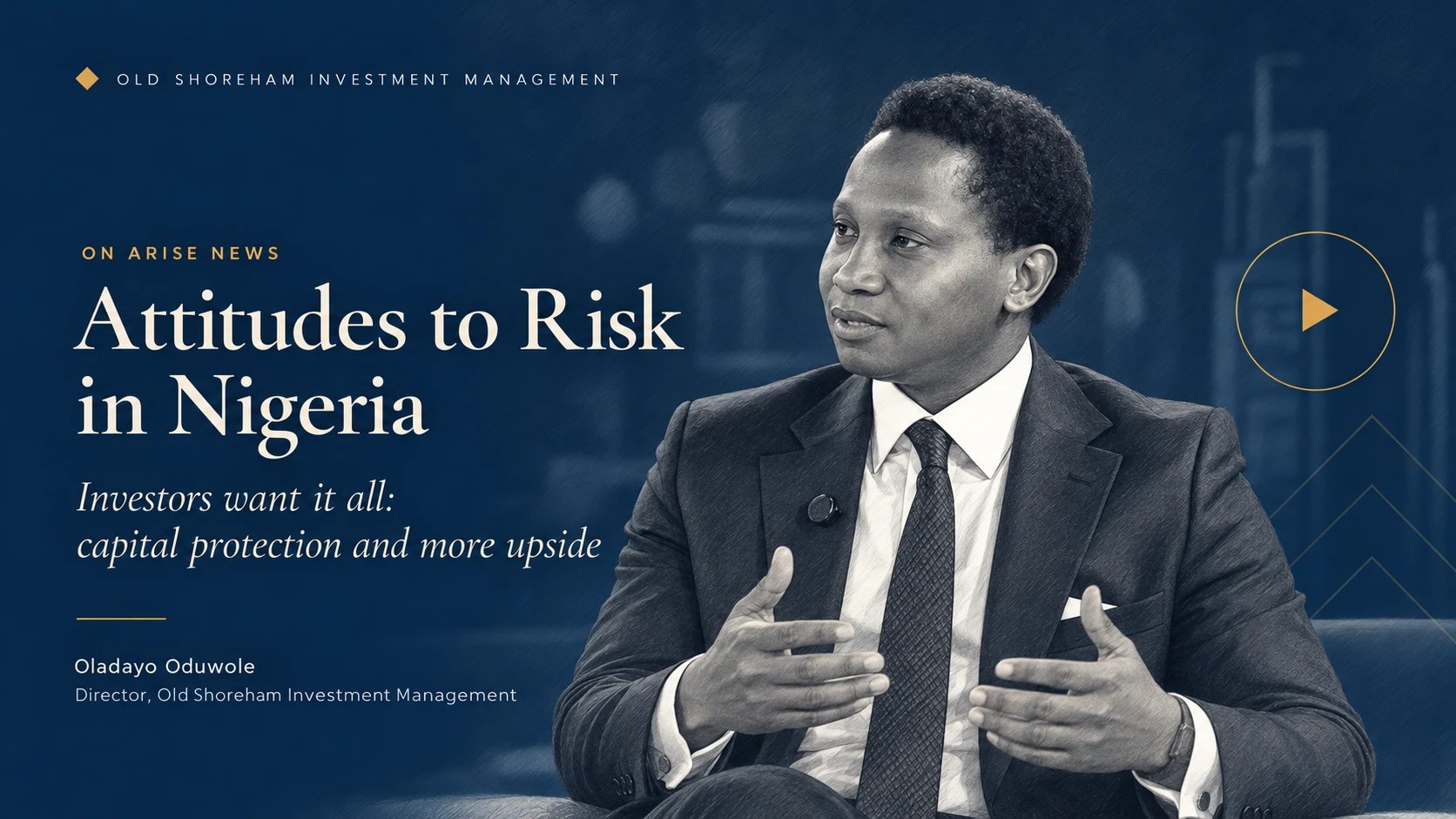
Oladayo Oduwole discusses the findings of Attitudes to Risk in Nigeria: what Nigerian investors say about risk, what they choose when asked, and the payoff shape that most of them are looking for. The study itself is under Nigerian Studies on this page.
Nigerian Studies
Our studies of Nigerian investors and the returns they keep.
Behavioural Research, 2026. Study
Attitudes to Risk in Nigeria
What Nigerians say and do about risk, and the missing payoff shelf
Attitudes to Risk in Nigeria
Most Nigerians meet an investment product through a forecast rate of return, and the question of risk arrives afterwards as a short questionnaire that sorts the customer into a band. This study measures attitudes to risk twice on the same 412 people, once through the Grable and Lytton stated scale and once through FREBO, our behavioural profiling engine. Asked what the word risk brings to mind, about half say uncertainty and fewer than one in ten say loss.
The choices point both ways. Three in five take the most defensive portfolio on offer, three in four prefer a chance at a larger prize to cash in hand, and two in five make both choices in a single sitting. That combination is largely absent from a shelf where money market funds hold two thirds of registered mutual fund assets, and the report specifies the payoff architecture the evidence asks for. The study remains in the field, and the sample is young, urban and concentrated in Lagos and the Federal Capital Territory.
Old Shoreham Investment Management (2026). Attitudes to Risk in Nigeria. Behavioural Research series.

Market Research, 2026. First annual edition
The Return You Keep
Investor returns in Nigerian mutual funds
The Return You Keep
A fund's published return is what one naira earned by sitting in it from the first day to the last. The return an investor keeps depends on when the money was actually in. This first annual edition measures both for Nigerian mutual funds, using the monthly data published by the Securities and Exchange Commission from January 2019 to December 2025, and reports the difference between them as a return gap. No fund is named or ranked.
Over the three years to December 2025, funds carrying price risk returned 13.8% a year while the money invested in them earned 13.4%, and about three in five such funds show a negative gap. Equity in 2025 is the sharpest case, at 55.2% for the funds against 49.1% for the money, because most of the year's new money arrived after the July rally. Money market runs the other way, and since it holds four fifths of naira fund assets it turns the industry aggregate positive.
Old Shoreham Investment Management (2026). The Return You Keep: Investor Returns in Nigerian Mutual Funds. First annual edition.
Working Papers
The theory and measurement behind our funds and payoff products.
Working paper, 2026. Measure
Behaviourally Realisable Return
Forecasting the investment an investor can actually hold
Behaviourally Realisable Return
The return printed on a factsheet is the return of holding to maturity. The return an investor realises is the return of the strategy she actually implements, exits included, and the two are rarely the same. This paper defines the behaviourally realisable return as the annualised certainty equivalent of implemented value, and the implementation drag as its gap to the certainty equivalent of holding, and then uses the measure to compare a family of floored notes with a family of constant-mix portfolios for investors of varying risk aversion under monthly monitoring.
The floor an investor should be given rises with her risk aversion, from roughly eighty-five percent of capital at log utility to par at the point where the note is dominated, and an investor of intermediate risk aversion is served almost exactly by the ninety percent floor that the market already sells. The implementation wedge survives every robustness check in the paper; the sharp corners and one-basis-point cliffs reported under annual monitoring do not, and are shown to be artefacts of the monitoring interval rather than features of the problem.
Oduwole, O. (2026). Behaviourally Realisable Return: Forecasting the Investment an Investor Can Actually Hold. Old Shoreham Investment Management working paper, prepared for journal submission.

Working paper, 2026. Theory
When Does Behaviour Reduce to a Wealth-Path Constraint?
Trigger vectors, filtration enlargement and the limits of pathwise representation
When Does Behaviour Reduce to a Wealth-Path Constraint?
An investor who abandons a strategy when the loss becomes unbearable is not optimising a new utility function; she is revealing a constraint on the paths she is able to hold. This paper makes that observation precise. It replaces the single exit threshold of the earlier literature with a vector of triggers, loss from inception, drawdown from the peak, lag against a reference asset, inactivity and irregularity, each with its own action, and shows that when a trigger reads only the wealth path and its action is absorbing, maximising the value an investor actually realises is equivalent to classical optimisation over a hard drawdown-constrained set. The behavioural contribution is an elicited personal feasibility constraint rather than a new objective, which is why it can be carried into a Merton problem without changing the mathematics of the problem.
The paper also draws the boundary of that result. Two products with identical terminal distributions can differ in every drawdown their holder must survive, so the order-invariant criteria that suitability rests on, volatility, Sharpe, Sortino, value at risk, expected shortfall and the terminal distribution itself, are together insufficient to rank products for a given person. And a trigger that reads external state, a benchmark, a peer, the news, admits no wealth-path representation at all, so part of what investors do cannot be handled as a constraint and must be handled as design.
Oduwole, O. (2026a). When Does Behaviour Reduce to a Wealth-Path Constraint? Trigger Vectors, Filtration Enlargement and the Limits of Pathwise Representation. Old Shoreham Investment Management working paper.
Working paper, 2026. Design
Does Behavioural Product Design Pay for Itself?
Assignment value, manufacturing spread and the boundary for behavioural instruments
Does Behavioural Product Design Pay for Itself?
A behavioural product is worth building only if the value it creates for the investors who can hold it exceeds the spread paid to manufacture it, and this paper prices both sides. Assignment value is the gain from matching investors to products by the path each can hold rather than by average product superiority, and it exists only where investors disagree about the ranking of products once conventional preferences are held fixed; a reversal that conventional preferences already explain is not a behavioural result. Manufacturing spread is what the option leg and the funding leg cost.
The boundary between the two is derived as a surface over the floor, the tenor, the investor's risk aversion and the interest rate. Breakevens run from under seventy basis points to several hundred depending on where one stands on that surface, and the region where design pays is identified: partial rather than full floors, longer tenors, and manufacture in-house rather than bought from a bank. In a high-rate, high-volatility market such as Nigeria the clearing structure is an above-par floor with reduced participation, and the breakeven there is largely attributable to implementation rather than to the conventional economics of the note.
Oduwole, O. (2026b). Does Behavioural Product Design Pay for Itself? Assignment Value, Manufacturing Spread and the Boundary for Behavioural Instruments. Old Shoreham Investment Management working paper.
The three papers are working papers and remain subject to revision; comments and referee reports are invited. The Nigerian study reports its findings as percentages of a sample that is still being finalised, so counts are not published and figures may move at the final edition. Correspondence to welcome@oldshoreham.com.